Reach relevant audiences across websites, apps, YouTube and the wider display ecosystem with visually engaging campaigns built to increase brand awareness, reconnect with high-intent users, and drive measurable action.
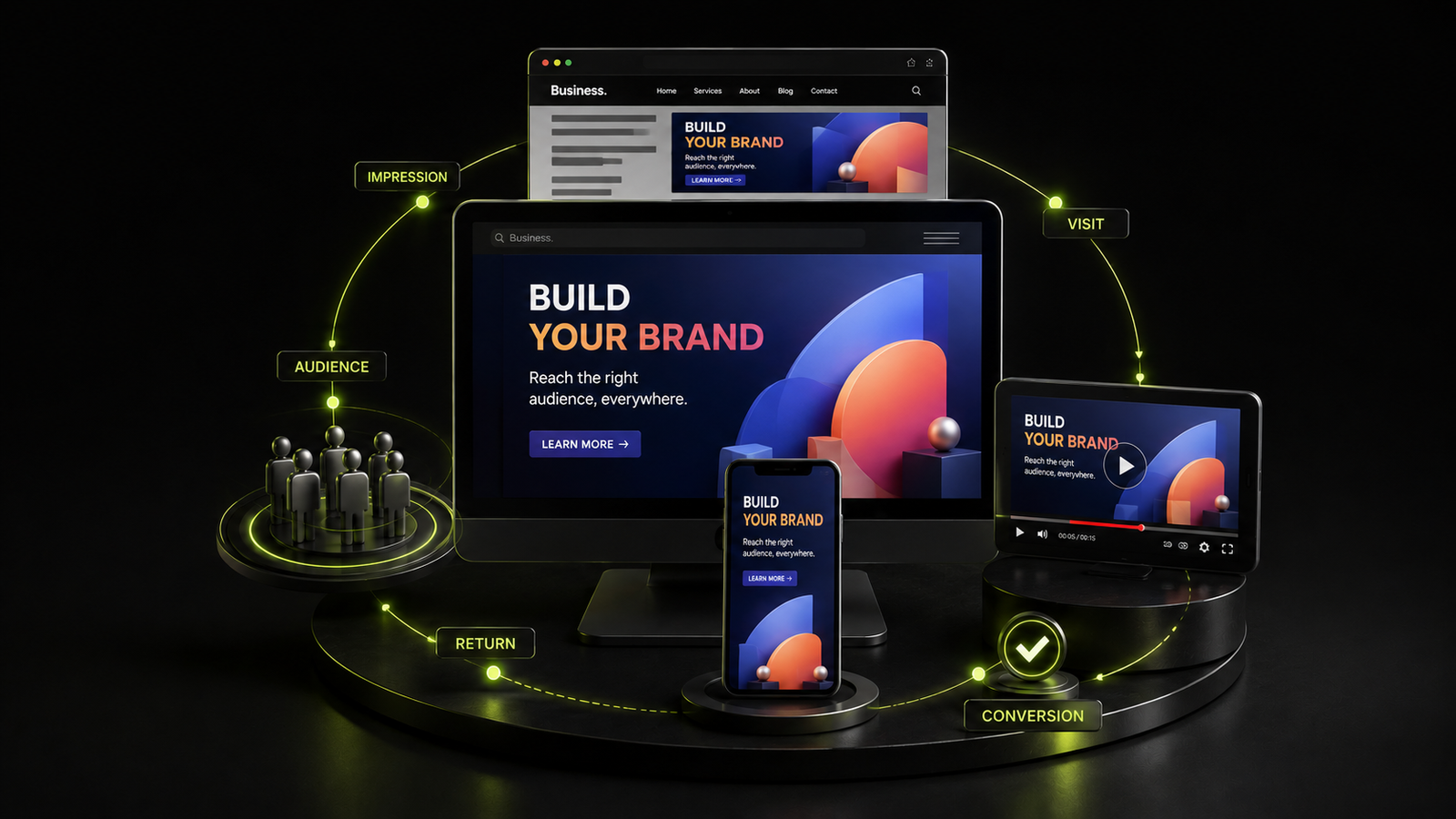
Customers rarely make decisions after a single interaction. Display advertising keeps your brand visible across the customer journey—building awareness before active search, reinforcing consideration after discovery, and reconnecting with interested audiences when they’re more likely to act.
Build visibility beyond active search.
Connect with relevant audiences across digital environments.
Bring previous visitors back into the journey.
Turn repeated, relevant exposure into measurable action.
High-performing display advertising brings strategy, audience intelligence, creative, media, remarketing and optimization together as one connected system.
We plan display advertising around your audience, funnel stage, budget, market and desired outcomes—creating a clear foundation before media spend begins.
We define and refine audience segments using demographics, interests, behaviour signals and first-party data so ads reach the right people.
We build responsive display, banner and video-ready creative designed to earn attention across every eligible placement.
We reconnect with previous visitors and high-intent audiences using messaging matched to where they are in the journey.
We access broader publisher inventory through controlled programmatic buying, with placement and brand-safety controls in place.
We review audiences, placements, creative and conversion data continuously, then move budget toward what actually performs.
We plan display advertising around your audience, funnel stage, budget, market and desired outcomes—creating a clear foundation before media spend begins.
Display advertising extends your reach beyond search, helping your brand stay visible across the digital environments your audience already uses. AdsLectic plans placements across websites, apps, video and relevant publisher inventory—then reconnects interested users through remarketing.
One campaign, planned across websites, apps, video and programmatic inventory — then reconnected through remarketing.
Our Display Advertising process connects audience research, campaign strategy, creative execution and continuous optimization—giving every campaign a clear path from planning to measurable performance.
Understand your business, market, audience and campaign goals to identify the right targeting opportunities.
Define audience segments, placements, budget, bidding approach and measurement goals before launch.
Develop relevant Display Ad creative, configure tracking and launch across selected advertising environments.
Review audience, placement, creative and conversion data to refine targeting, bids and budget allocation.
Scale stronger-performing opportunities and provide transparent reporting with next-step recommendations.
Display advertising compounds when audiences, creative and optimization work together as one connected system.
We don’t just run ads. We build growth engines that deliver real impact.
Every strategy is backed by data, insights and performance analytics.
We reach the right audience with the right message at the right time.
High-performing creatives designed to grab attention and drive action.
We continuously test, optimize and improve to maximize ROI.
Clear communication, honest reporting and a team you can count on.
Partner with a team that treats your growth targets as its own.
Display advertising works differently across industries because audiences discover, evaluate and purchase in different ways. AdsLectic adapts targeting, creative, placements and remarketing strategies around each customer journey.
Campaign planning, activation and measurement powered by the platforms that connect brands with audiences across the digital journey.
The right platforms, the right inventory and the right data behind every display campaign.
Display Ads are visual advertisements that can appear across websites, apps and eligible Google properties. They use images, text, video and responsive creative formats to reach audiences while they browse content online. Display advertising can support brand awareness, consideration, website traffic, remarketing and conversions depending on the campaign objective.
The Google Display Network (GDN) is a network of websites, apps and Google-owned properties where eligible Display Ads can appear. It allows advertisers to reach audiences beyond Google Search while they browse websites, use apps, watch videos or interact with online content.
Search Ads primarily reach users actively searching for something, while Display Ads can reach audiences as they browse websites, apps and other digital content. Search is typically stronger at capturing existing intent, while Display can help build awareness, influence consideration and reconnect with audiences throughout the buying journey.
Google Display Ads can appear across eligible websites and mobile apps on the Google Display Network, as well as certain Google properties and environments depending on campaign type and inventory availability. Placements vary based on targeting, campaign settings, eligibility and Google’s advertising ecosystem.
Yes. Display advertising can be particularly useful for brand awareness because visual ads allow businesses to reach audiences before they actively search for a brand. Campaigns can be optimized around reach and viewable impressions, helping businesses build recognition and remain visible throughout the customer journey.
Display Ad targeting helps advertisers reach audiences using signals such as demographics, interests, active research behaviour, previous interactions and relevant content. Campaigns can also use topics, placements and other content-targeting controls to influence where ads appear.
Display remarketing—now commonly referred to by Google as using your data segments—helps businesses reconnect with people who have previously interacted with their website, app or ads. It can keep your brand visible after an initial visit and encourage interested users to return and complete a desired action.
Yes. Businesses can use eligible first-party audience data to reconnect with previous website visitors through supported Google Ads campaigns. Remarketing strategies can differentiate audiences based on prior interactions, allowing messaging and bidding strategies to reflect different levels of customer intent.
Responsive Display Ads use combinations of advertiser-provided assets such as images, logos, headlines and descriptions. Google can automatically adapt the size, format and appearance of the ad to fit available inventory, helping campaigns serve creative across a wider range of eligible placements.
Yes. Display campaigns can be optimized for actions such as leads, sign-ups and purchases when appropriate conversion tracking is in place. Depending on the objective and campaign eligibility, bidding strategies can focus on conversions, target CPA or return on ad spend rather than simply maximizing impressions or clicks.
Contextual targeting helps place Display Ads alongside content relevant to selected topics, keywords or themes. Google analyzes page content and other contextual signals to determine relevance, helping advertisers connect their message with users consuming related content.
There is no fixed Google Display Ads cost. Spend varies according to factors such as audience, industry, competition, placements, bidding strategy and campaign objective. Display campaigns can use different bidding approaches based on whether the priority is impressions, clicks, conversions or conversion value.
There isn’t one Display Advertising budget that works for every business. The appropriate investment depends on your target audience, market size, campaign objective, expected conversion value and available data. AdsLectic can recommend a starting budget and scale investment based on actual campaign performance rather than arbitrary spend levels.
Important Display Advertising metrics can include impressions, reach, viewability, clicks, click-through rate (CTR), conversions, conversion rate, cost per acquisition (CPA) and return on ad spend (ROAS). The right KPIs depend on whether your campaign is focused on awareness, traffic, lead generation or revenue.

A good Display Ads CTR varies considerably by industry, audience, creative, placement and campaign objective. Instead of judging success against one universal benchmark, AdsLectic evaluates CTR alongside conversion rate, CPA, ROAS, audience quality and other campaign outcomes to understand whether engagement is producing meaningful business value.
AdsLectic continuously reviews audiences, placements, creative performance, bidding, budgets, frequency and conversion data. Insights from campaign performance are used to test new variations, reduce inefficient spend and allocate more budget toward the audiences, creatives and placements producing stronger outcomes.
Display Ads can begin generating impressions and traffic soon after an eligible campaign launches, but meaningful performance analysis requires enough data to evaluate audiences, creatives, placements and conversions. AdsLectic monitors early campaign signals and continuously optimizes as sufficient performance data becomes available.